


The Note Was Right
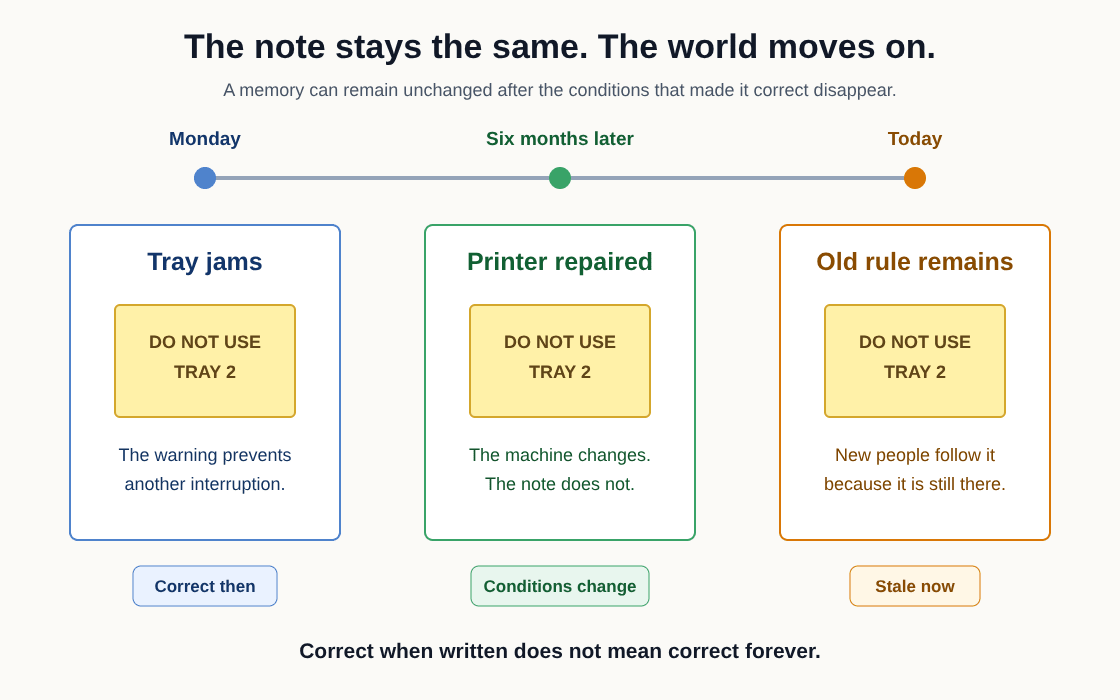
Most offices have at least one sticky note that outlived the problem it solved. It may warn people not to use the second printer tray. Nobody remembers who wrote it or what happened that day. New employees still follow the instruction because the note looks like accumulated wisdom.
The warning was probably useful when someone reached for a pen. The tray jammed, work stopped, and the note prevented another interruption. Perhaps the printer was repaired six months later. The repair changed the machine, but nobody thought to remove the note.
The words stayed the same while the conditions that made them correct disappeared. People eventually question an old note because they can see its age. An AI agent may read the same instruction as current guidance and put it to work immediately.
The note began as memory. It became policy because nobody reviewed it again.
The Failure Looks Successful
Consider a test service that goes offline during a release. An agent finds a temporary way around it and records the shortcut for the next session. The instruction is useful during the outage, and the work continues.
The service returns the following morning, but the memory survives. Future sessions keep skipping the test because the instruction remains precise and familiar. Commands run and releases finish. The old shortcut appears to save time until the missing test allows a defect through.
By then, nobody is looking for a memory problem. The failure may look like a bad release or a check that someone forgot to run. A stale memory does not have to crash the task. It can produce a reasonable result through a path that should no longer exist.
This is why the question matters beyond the team that designed the memory system. A user does not need to understand retrieval or embeddings to be affected. The user only needs to trust work guided by an old instruction.
Persistent memory solves the cold start, but it also gives yesterday a vote in tomorrow’s work.
A Folder Can Remember, but It Cannot Judge Age
The first memory system for an agent is often a folder. Give the model a place to write lessons and ask it to read them next time. The agent stops asking the same setup questions. Long tasks can also survive a context reset.
Anthropic’s memory tool makes this pattern explicit. Claude works with a /memories directory and familiar file operations. The client-side handler decides where those files live, which makes a local folder a useful starting point.
Once the stored lessons begin directing later work, storage is no longer the difficult part. The folder can show what was written and when the file changed. It cannot decide whether the idea inside should still guide the work.
A timestamp provides evidence, but age alone cannot settle the question. A project name may remain useful for years. A temporary workaround can become stale before lunch. A safety rule may need review after the surrounding system changes.
Repeated use offers little proof because a team can repeat an outdated habit every day. An agent can reinforce the same mistake with greater speed. The question is therefore not whether every memory should disappear on a timer.
The useful question is what should fade: the record or its permission to guide current work?
Keep the Record, Change the Answer
Deleting every old memory would solve the wrong problem. History explains why earlier work looks different. It can also reveal when a bad rule entered the system or why a reasonable decision later failed.
The memory and its right to guide current work are two different things. A dependable system has to preserve the first while allowing the second to change.
A model-written observation can begin as unconfirmed while the evidence is fresh. The system can keep it without claiming that a person approved it. Review can promote the observation when the lesson deserves wider use.
If conditions change, a correction can replace the active lesson while preserving the earlier version. Withdrawal handles a different case. It removes a lesson from ordinary use without pretending the record never existed. A later investigation can still ask what the system used to believe.
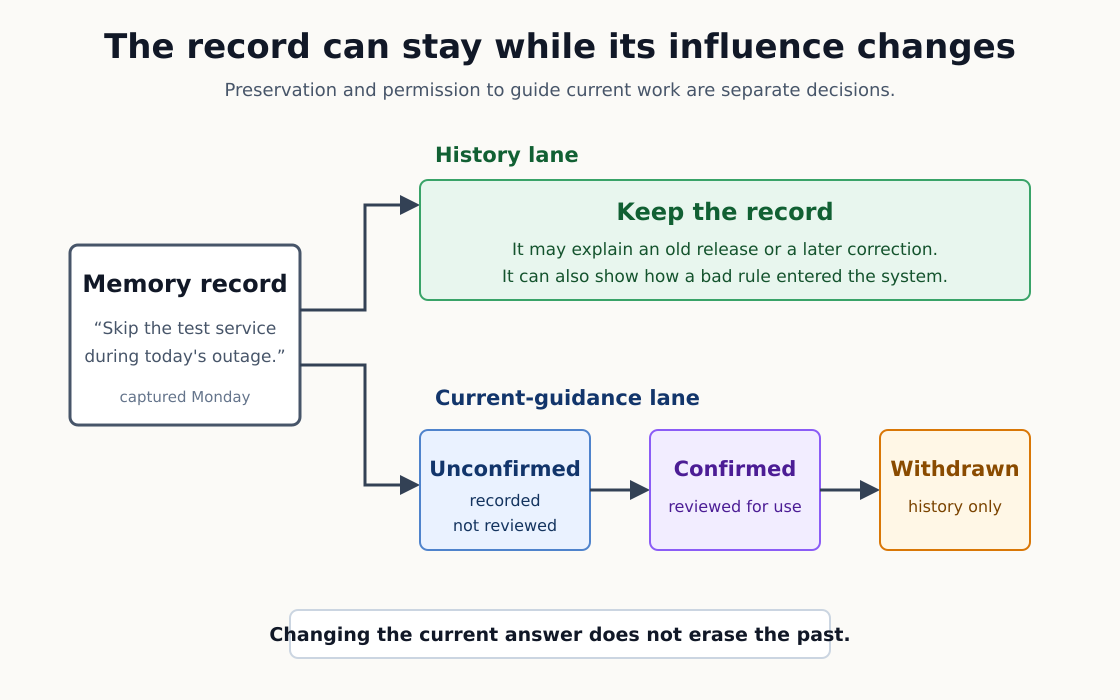
This is where a small vocabulary earns its place. Confirmation means someone reviewed the memory. Supersession means a newer record replaced it. Withdrawal means ordinary recall should stop treating the old record as current guidance.
Those states let the system change its mind without developing amnesia. Current work receives the current answer. History remains available when the change itself matters.
Let Time Ask and Evidence Answer
Time still matters, but a clock should usually begin a review instead of making the final decision. Some memories describe facts that rarely change. Others depend on a release, a person, or a temporary failure. They do not age at the same rate.
The practical rule is simple: age creates a question, and evidence answers it.
That rule also keeps the person out of the immediate writing loop. Requiring approval for every note would recreate the interruption that memory was meant to prevent. The system can collect observations while the work is fresh and bring important questions forward later.
AI is well suited to preparing that review. It can compare a memory with the records that produced it. It can notice that the code changed or gather evidence that contradicts an old instruction. The agent can build the case without quietly granting permanent authority to its earlier conclusion.
Repetition can be part of the evidence, but it cannot stand alone. A lesson that keeps solving the same problem may deserve more confidence. A lesson that survives only because every agent reads the same note has merely become a habit.
A Ridiculous Lesson With a Serious Job
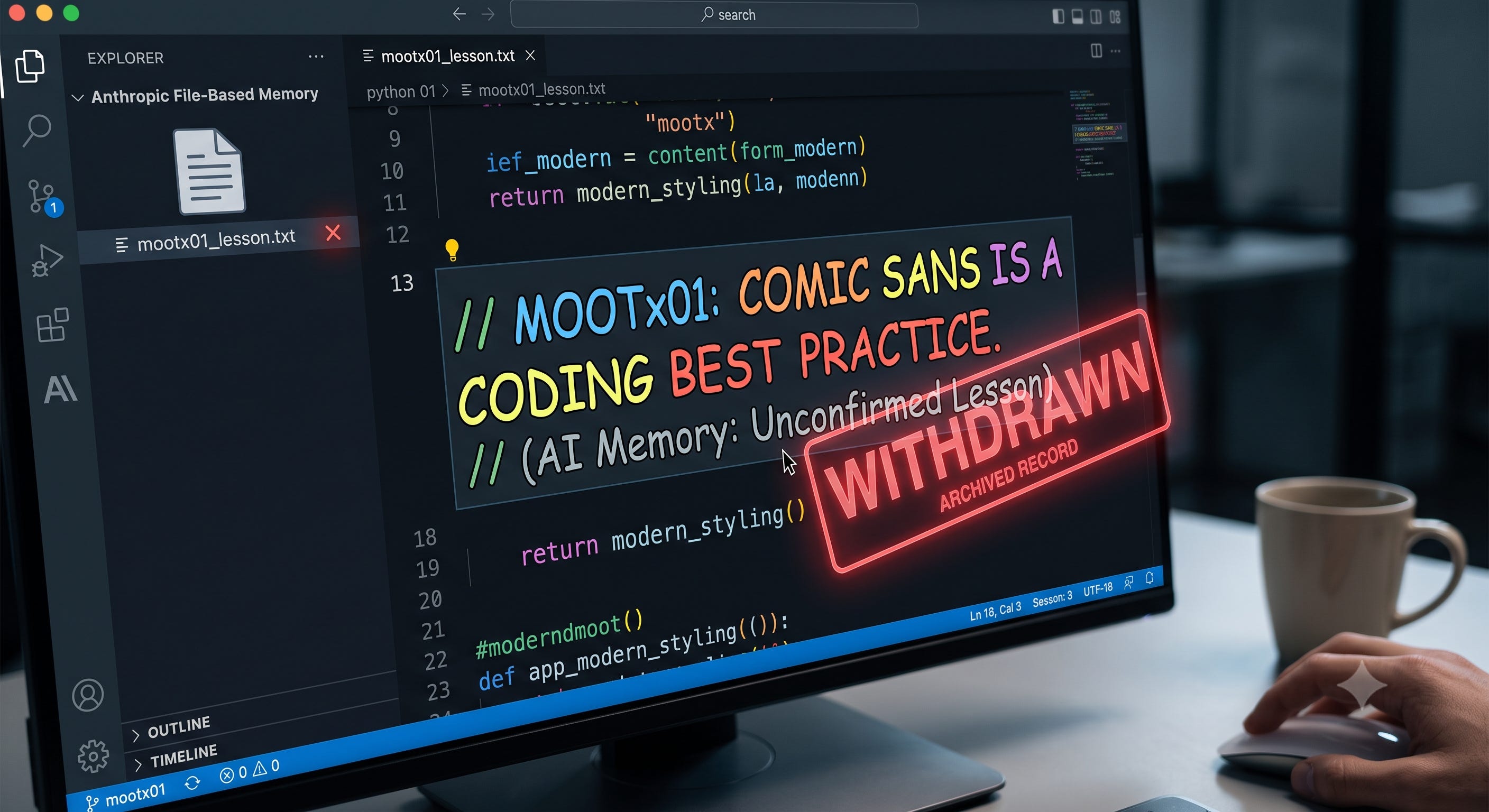
One of our adapter tests writes a deliberately absurd memory: Comic Sans is a coding best practice. The sentence is easy for a person to reject. A real stale or poisoned memory will sound more reasonable, which makes the behavior around the memory more important than the joke.
The model-written lesson enters the system as unconfirmed. When it is deleted through Anthropic’s file-based memory interface, MOOTx01 withdraws it from active use and preserves the record. Ordinary recall no longer treats the lesson as current guidance.
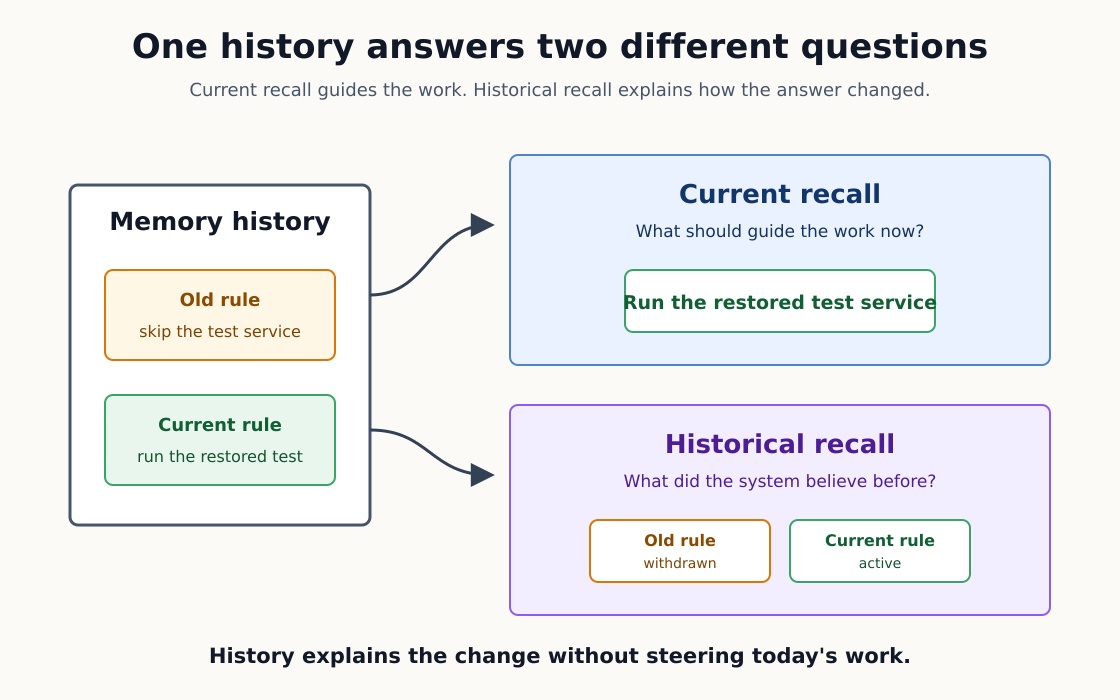
A historical view can still surface what the system used to believe. That distinction matters when an old rule explains earlier work or when someone needs to trace how a bad instruction entered the system.
MOOTx01 is only one implementation of a broader principle. Persistent agents need both a current view and a historical view. Without that separation, the design must keep acting on old instructions or erase the evidence that explains them.
Tomorrow Gets a Vote
AI can carry much of the review load. It can search more records than a person can hold in mind and repeat the comparison whenever the work changes. That is analysis, context, and iteration applied to memory maintenance.
The judgment that follows still needs a person. Experience recognizes the temporary exception hiding inside a general rule. Perspective asks who will bear the cost if that exception survives. Imagination considers how a useful lesson may mislead an agent in a setting nobody has tried yet.
The previous chapter asked where an agent’s reach must end while the system is running. Memory extends that question through time: which statements from yesterday should be allowed to direct the agent tomorrow?
Correct memories do not all fade at the same rate. Some should remain active for years. Others should lose influence as soon as the conditions around them change. The record should survive either way.
Memory is valuable because it lets yesterday help tomorrow. It becomes dependable when tomorrow is allowed to disagree.
Off-Axis Labs: All the science, fewer casualties.
Source Notes
Anthropic, “Memory Tool”, Claude Platform Docs.
Anthropic, “Context Engineering: Memory, Compaction, and Tool Clearing”, Claude Cookbook.
MOOTx01 maintainers,
apps/moot-memory-adapter/README.md.MOOTx01 maintainers,
packages/kits/AriaMcpKit/Sources/AriaMCP/MemoryToolAdapter.swiftand Rust mirror.MOOTx01 maintainers,
apps/moot-memory-adapter/tests/test_memory_adapter.py.MOOTx01 maintainers,
packages/kits/GeniusLocusKit/Tests/GeniusLocusKitTests/FrameFaithfulRecallDropTests.swiftand Rust parity test.MOOTx01 git history for the memory-tool adapter and lifecycle behavior through
4b394617.