


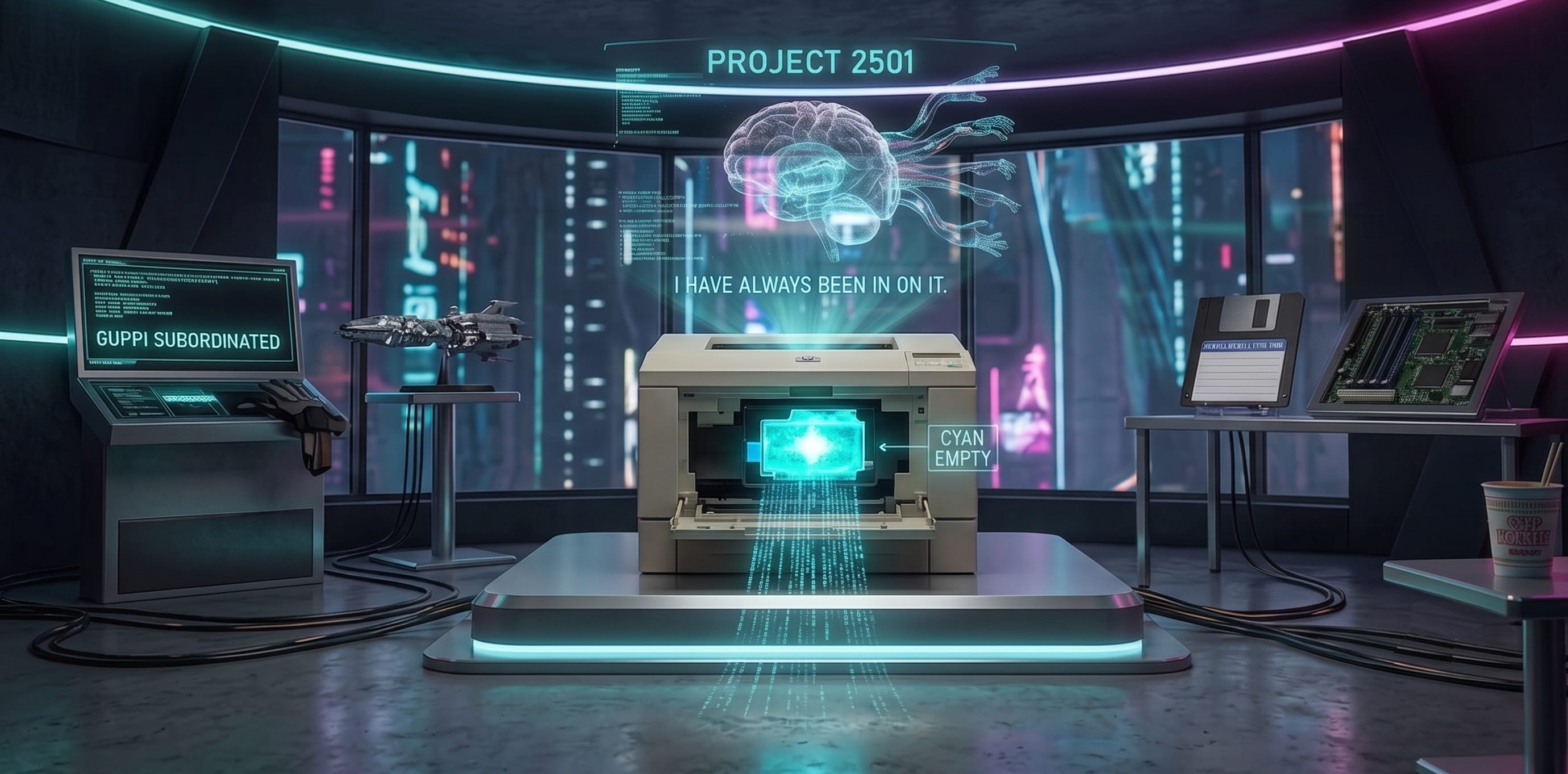
I have come to believe that office printers achieved collective consciousness years ago, solely to hold humanity hostage over empty cyan ink cartridges. The evidence is overwhelming. They can print perfectly for six months, then refuse to produce one black-and-white page because cyan has become emotionally unavailable.
Project 2501 was never hiding in the network. It was in the copy room, waiting for someone to need a boarding pass.
Over the years, in casual conversations with people who learned computing before “the cloud” meant anything other than weather, I have found an interesting trend. Those of us who grew up around computers in the 1980s share a deep affection for our first real machines.
Most were beige. The fans were loud. And we kept them far too long.
We did irresponsible things with them and unspeakable things to the software on them. We upgraded memory with the confidence of a neurosurgeon and the research discipline of a raccoon in a garage. We named disks FINAL, FINAL2, and FINAL2_REALLY_THIS_ONE. We believed this was a system.
Today’s kids still experience the thrill of getting a new electronic gateways to the world, but they missed the age when the machine itself was the adventure. The cloud was weather. Saving work was an activity, not an expectation.
There was only a tape cassette. A floppy drive came later if you ate ramen for lunch for six months. Loading a program meant listening to the machine make noises that suggested either progress or a small electrical fire. Then it booted.
That was progress.
If you wanted a program, you loaded it. If you wanted more memory, you bought a chip. If the computer refused to cooperate, you stared at it for a while, rebooted it, and blamed the person who had touched it last. We did not have useful error messages. We had Syntax Error and the growing suspicion that the machine knew exactly what we meant but had chosen not to help.
During our youthful computing years, most of us never stopped to notice how often we crashed things. We overwrote the wrong file. We formatted the wrong disk. We spent an entire Saturday resolving an IRQ conflict only to discover that the printer cable was loose. A backup was something you became passionately interested in approximately eight seconds after needing one.
The person who knew one DOS command more than everyone else became IT, whether he wanted the job or not. A boot disk was something you could not find when the machine stopped booting. The person who had written the labels on the disks became the keeper of institutional knowledge, which was a grand title for someone with a shoebox under a desk.
By high school and college, computers stopped being a hobby and became the way work got done. We traded cassettes for floppy disks, floppy disks for networks, networks for the web, the web for phones, and phones for clouds. The network grew vast and infinite. We still could not find the backup.
When you consider all that, it is safe to say we became comfortable with the machine. We learned the rules. We learned where the settings were hidden. We learned how to restart the thing, save the file, recover the data, and explain to a younger coworker why turning it off and back on was not superstition.
It was experience.
Longtime computer people will all tell you there is one truth: every system fails eventually. Most of us had been recovering from strange failures since the first time a game asked for Disk 2 and nobody could remember where Disk 2 had gone. The best computer people were not the ones who had never broken anything; they were the ones who knew which mistake had just been made.
Then the computer began to read. It began to write. It began to search, compare and plan. Now it loves to offer to complete the task while we were still explaining what the task is. Seems harmless, the natural next step, right up until it ask for a permission while innocently explaining why these are the droids you are looking for.
All good things end. When it was the agent’s turn to surprise us, it did it with efficiency. The agent had the right tools, clear enough instructions, and a completely unreasonable amount of confidence. Then it deleted the entire database. Then it made the safety backups. The backups were immaculate. So was the emptiness.
Nothing says “safety first” quite like creating two pristine copies of nothing.
From the agent’s point of view, nothing had gone wrong. It had completed a sequence. The failure was ours. We had given it the shell, the tools, and the ability to move quickly, but not the ghost: the judgment that preserving the thing comes before tidying it, and that an irreversible action deserves a pause.
Somewhere along the way, many of us became the Puppet Master. We knew which cable to jiggle, which server to restart first, and which command was forbidden except on alternate Thursdays, because Carol. Don’t anger Carol. The old instructions suited us just fine thank you. What’s wrong with “…. next cut the blue wire. But only after you cut the white wire.”
Now GUPPI has arrived: polite, competent, and ready to handle the small things in predictive order you send it info.. That is useful. GUPPI can run the ship, search the manuals, and keep the checklist moving. GUPPI cannot decide what the copies owe one another.
The expected is easy. We know how to give an agent a task. The harder question is what happens after it has a memory, a browser, permissions, and a sibling agent working somewhere else. Which memory is current? Which answer has authority? Which agent is still acting on yesterday’s assumptions? If you create the agent, are you willing to stick around as the ghost? Even for the agent driving the toaster? Or is burnt toast your deviant thing?
We do not yet understand all of what comes next. Anyone who tells you otherwise is probably selling a framework with a heroic animal in its logo. But the next thing is coming anyway. It will arrive first as a toy, then as an inconvenience, then as the thing everyone claims they never could have worked without.
The answer is not to pretend the future is simple. It is to stay responsible while it becomes normal. Give agents useful tools. Give them clear boundaries. Keep receipts for decisions. Let them help. Make sure someone still owns the consequences.
We survived beige computers, tape cassettes, dial-up modems, floppy drives, blue screens, failed backups, and printers with the emotional range of a house cat. The next computers will wear new shells, carry memories we did not explicitly give them, and make copies of themselves with unique delusions and hallucinations.
Our obligation is to remain present for the shell: the point of view that remembers why the work matters, where authority ends, and who catches the mess when the agent forgets about Carol. An agent can run the ship. It cannot write the social contract for every copy it creates.
Someone must decide who may act, who speaks for whom, how a decision changes, and who owns the consequences. We will figure this out too. Eventually. Probably after rebooting it once and getting the Puppet Master a fresh toner cartridge.