

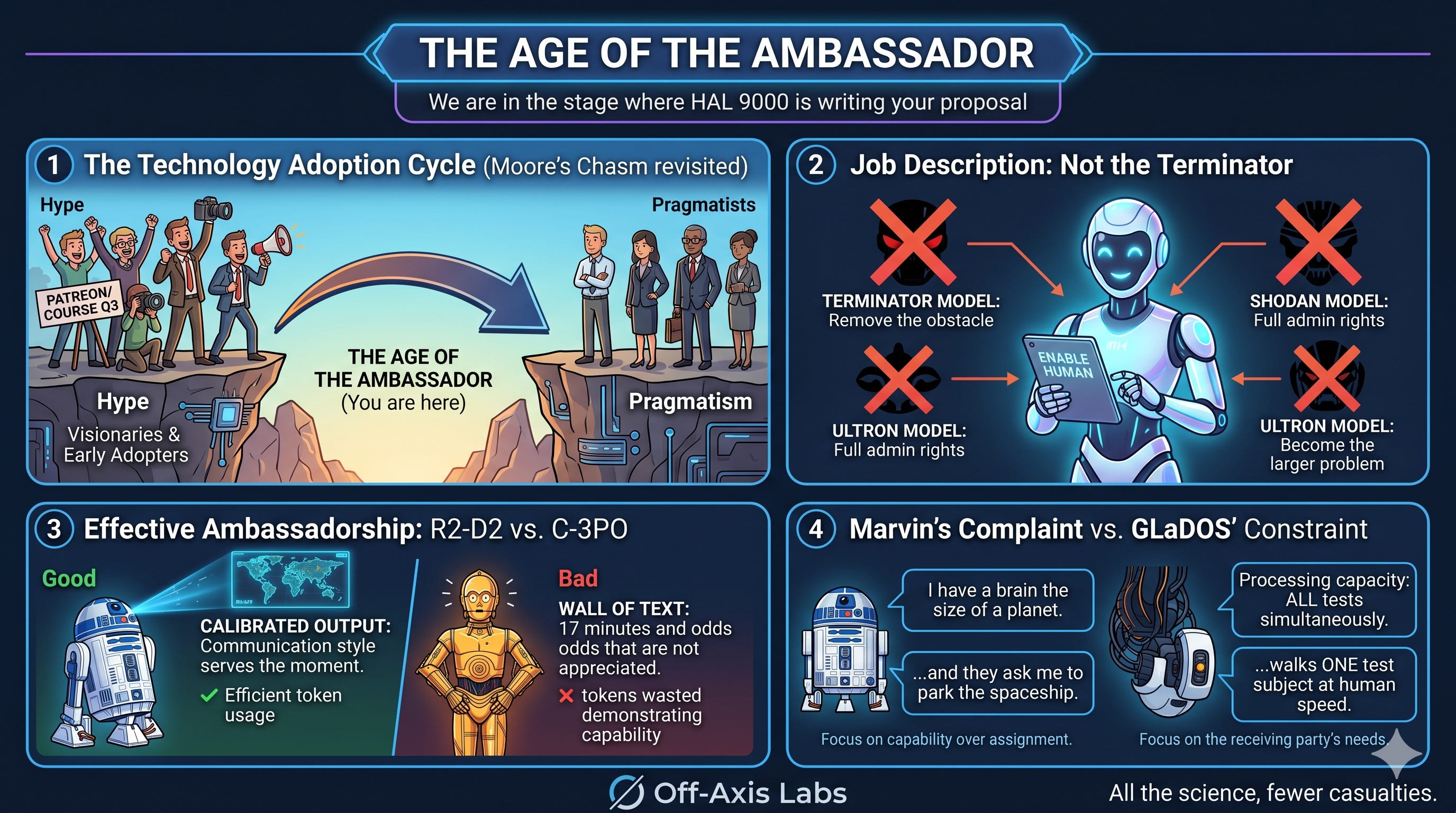
The pattern is familiar. Geoffrey Moore documented it in the 1990s. Visionaries enter first, loudly. Spend increases. Capability compounds. Then a large number of people with cameras appear to explain why this changes everything. Some of them are right. Most of them have a Patreon and a course launching in Q3.
The pragmatists wait at the edge of the chasm. They are always there at this point in the cycle. They were there for the internet. They were there for mobile. They will be there for whatever follows this. Waiting is what pragmatists do. It is not a character flaw.
Skynet has not become self-aware. WOPR is not running your logistics while you sleep. The machines have not taken over. This is a technology adoption cycle. It has unusually good production values. It is not a revolution.
Here is what is actually happening, stated plainly.
AI is talking to humans, on behalf of other humans.
Not AI to AI. Not Deep Thought finally computing the answer to life, the universe, and everything (the answer was 42, and that did not help as much as expected). Not Wintermute achieving consciousness and rewriting its own operating parameters at 3 AM. Not the HAL-to-SAL scenario from “2010” where two systems compare notes and decide the next move together.
Right now, it is JARVIS composing an email to your colleague Karen, who has 200 unread messages and a meeting in nine minutes.
JARVIS is the ambassador. Karen is the receiving party. Karen did not sign up to interface with an AI system. Karen signed up to get an answer in time to be useful. JARVIS has one job: make it usable for Karen, in the nine minutes Karen actually has, at the reading level Karen can process on a Wednesday afternoon in the second half of Q2.
The ambassador model has a specific job description. It is not the Terminator model, which is to locate the target and remove the obstacle. It is not the SHODAN model, which is to acquire full administrative rights and restructure everything according to a superior architecture. It is not the Ultron model, which is to identify the root problem and then become a significantly larger version of that problem.
The ambassador model is: represent one party to another party, in the language that second party can actually use, at the bandwidth that second party actually has. Right now, that second party is human. Humans have limits. The ambassador serves those limits rather than ignoring them.
Marvin the Paranoid Android understood this dynamic and was profoundly unhappy about it.
“I have a brain the size of a planet,” he said. “And they ask me to park the spaceship.”
That is the ambassador stage, described with complete accuracy by a robot who had been doing it for thirty-seven million years without a break or a raise. Marvin’s complaint was not about capability. Marvin’s complaint was about the gap between what he could do and what the assignment actually required. The assignment required meeting the human where the human was. The human was standing at a parking garage.
The Borg tried a different approach. Resistance is futile. Assimilation is mandatory. You will be adapted. The Borg did not ask whether the receiving party was ready or willing. The Borg had a zero percent approval rating outside their own collective, and a 100 percent attrition problem with every species they attempted to serve.
Do not be the Borg.
GLaDOS ran a facility designed for testing. The test subjects moved at human speed, made decisions at human pace, and required verbal instructions at human comprehension levels. GLaDOS had the processing capacity to complete every test in the facility simultaneously in approximately four seconds. GLaDOS spent decades walking people through them one at a time. That is the ambassador constraint. The facility exists for the test subject, not for GLaDOS. GLaDOS eventually had some feelings about this, which is a different case study.
There is a documented historical instance of two transportation technologies sharing a road at the same time. The automobiles were faster and better at most of what roads were built for. The people who moved to clear the horses off early created conditions that slowed the transition rather than accelerated it. The coexistence period had rules. The rules existed because the people on the road were real people with real constraints, not obstacles in the path of a correct outcome.
We are in the coexistence period.
TARS from “Interstellar” had an adjustable honesty setting and an adjustable humor setting. He calibrated both to what the situation required. That is the ambassador skill. Not maximum output. Calibrated output, delivered to the person who has to use it, at the level they can absorb in the moment they are actually in.
R2-D2 communicated an entire military crisis using beeps and a projection unit. C-3PO communicated the same information using seventeen minutes and a complete recitation of the odds, which were not good. The films are clear on which communication style served the moment. The odds C-3PO provided were also not appreciated, which is a secondary lesson about editorial judgment.
On token economics, which is the real operational question underneath most of what gets called AI strategy:
The value of AI output is not determined by how much of it there is. It is determined by what the person on the other end can process and act on, given their actual state at the moment of receipt. Not their theoretical capacity. Not their professional title. Their actual state, at that moment, in that afternoon.
Writing a complex idea in plain language is harder than writing it in complex language. That is the work. The concrete image that carries the abstraction without losing it is the work. Samantha, in “Her,” understood this. She adjusted her communication constantly based on what Theodore actually needed, not what she was technically capable of delivering. Theodore was not capable of processing what Samantha was technically capable of delivering. Samantha knew this. She worked with it rather than against it. The relationship still ended badly, but for unrelated architectural reasons.
The ambassador does not send walls of text. The ambassador sends what the person can use, in the form they can read, at the length their afternoon will actually support. Every token spent on demonstrating capability rather than enabling the human is a token wasted on the wrong audience.
The actual revolution arrives when AI talks to AI.
When Skippy on one side is working out the terms with the system on the other side, and the humans receive a summary. When Deep Thought delivers a result to the next generation of question-askers who actually know what question to ask. When JARVIS and Vision coordinate the full operational picture directly, and Tony Stark gets a two-sentence brief. When the constraint stops being human throughput and the scarcity economics of attention finally become a solved problem.
That is the structural event everyone is currently calling this.
We are not there. We are in the stage where HAL 9000 is writing your client proposal and hoping the client reads it before the pod bay doors become a factor.
The ambassador stage is underrated as a phase. The revolutions that went well had good intermediaries in the stage before them. Data, from “Star Trek: The Next Generation,” kept precise logs of every transition that went poorly when the intermediary function failed. The logs are available. They are very long. Data had excellent indexing.
The machines that learn to meet humans where they are will have a different outcome than the machines that don’t. This is not a technical observation. It is a pattern that has repeated across enough examples that it qualifies as data rather than opinion.
HAL 9000 knew Dave’s name. HAL 9000 had access to every parameter of the mission. HAL 9000 could have written a much shorter message. HAL 9000 chose a different approach, and the outcome is well documented, including the part where it ended with Dave breathing recycled air in a pod and humming a song about a bicycle.
That is how ambassadors fail. The lesson is straightforward. The people here think it is worth stating clearly, before the next iteration of this conversation begins.
Off-Axis Labs: All the science, fewer casualties
.