



A permission prompt appears at the exact moment someone is trying to do something else. The application wants access to a folder, a camera, a location, or a private record. The person reads enough to recognize the request, clicks a button, and returns to the work.
The box disappears. The permission does not.
From the user’s side, the prompt was the security feature. It asked a question, waited for a person, and recorded an answer. Product teams reinforce that impression because the prompt is the part they can see, write, test, and debate.
The important behavior begins after the interface is gone.
The click raises questions about scope and time because access to one record is different from access to every record of that kind, just as one action is different from every future session. Unless the product defines renewal, revocation, and restart, a temporary decision can become durable state. Later review also needs enough evidence to show how that authority was used.
The wording in the box cannot answer those questions by itself. The answers live in the system behind it.
A prompt can collect a decision. A security model determines what that decision is allowed to mean.
We Spend Time on the Part People See
The prompt deserves care. A vague request encourages people to approve access they do not understand. A frightening request can make a useful product feel dangerous. A prompt shown too often teaches the user to click through it without reading.
Those are product problems, but they are not the whole permission problem.
The larger risk is quiet. A person approves one useful action, and the resulting authority becomes background state. The application keeps using it because nothing in the design requires the permission to end. Months later the user remembers the prompt as a small request made during setup, while the software remembers it as a permanent answer.
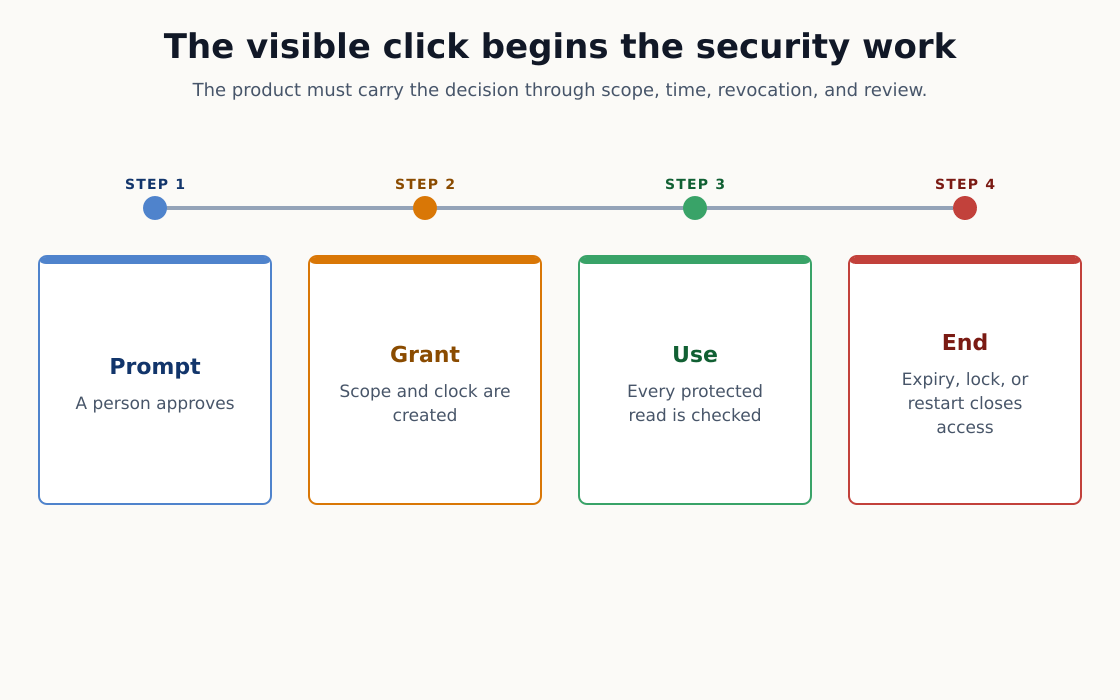
Agent-operated software makes that gap more important. The person may approve access because the agent needs one private fact to finish a task. The agent can then make dozens of tool calls while the grant remains active. Another session may arrive with different instructions, different source material, and the same inherited authority.
The security decision is therefore larger than, “Did a person click Allow?” It includes every use made possible by that click.
The previous security chapter in this series dealt with the approval path itself. If an agent can call the tool that grants more authority, the agent controls both the request and the approval. The stronger design moves the approval into a channel the model cannot operate.
That separation answers who may grant access. The life of the grant still needs its own answer.
A Grant Needs a Shape
We met this problem while adding private and secret memory to our memory system. The easy part was hiding sensitive records from ordinary recall. The harder question was how a person could temporarily include them without turning one approval into permanent background access.
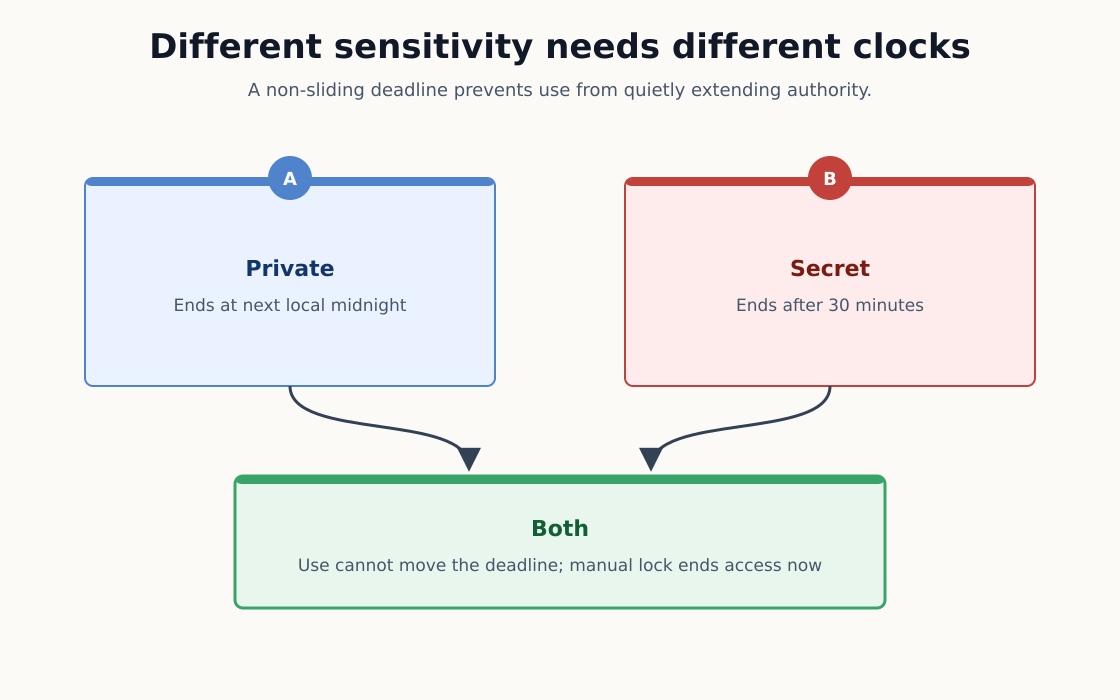
The first useful distinction was scope. Private material and secret material do not carry the same cost, so they do not share one grant. Approval for the private tier does not imply approval for the secret tier.
The second distinction was time. Private access ends at the next local midnight. Secret access lasts for a fixed thirty minutes. The secret window does not move forward each time the agent reads another record.
That non-sliding clock matters. If activity renewed the grant, a busy or compromised agent could keep secret access alive by continuing to use it. A thirty-minute permission would really mean thirty minutes after the agent finally stopped.
The third distinction was storage. The grants live in the resident service’s memory rather than in the estate. Restarting the service removes them. Yesterday’s approval cannot return from disk as today’s access.
Manual lock clears the grants immediately. Locking needs no identity challenge because it reduces access. Approval, denial, revocation, and each protected read leave an audit event without copying the protected content into the log.
The visible prompt still matters, but none of those protections come from the prompt. Protection comes from the grant ledger, the recall gate, the clock, the restart behavior, and the audit path. Together, those mechanisms form the security model.
The Model Is Also a Set of Limits
Security language gets into trouble when the product promises more than its boundary can enforce.
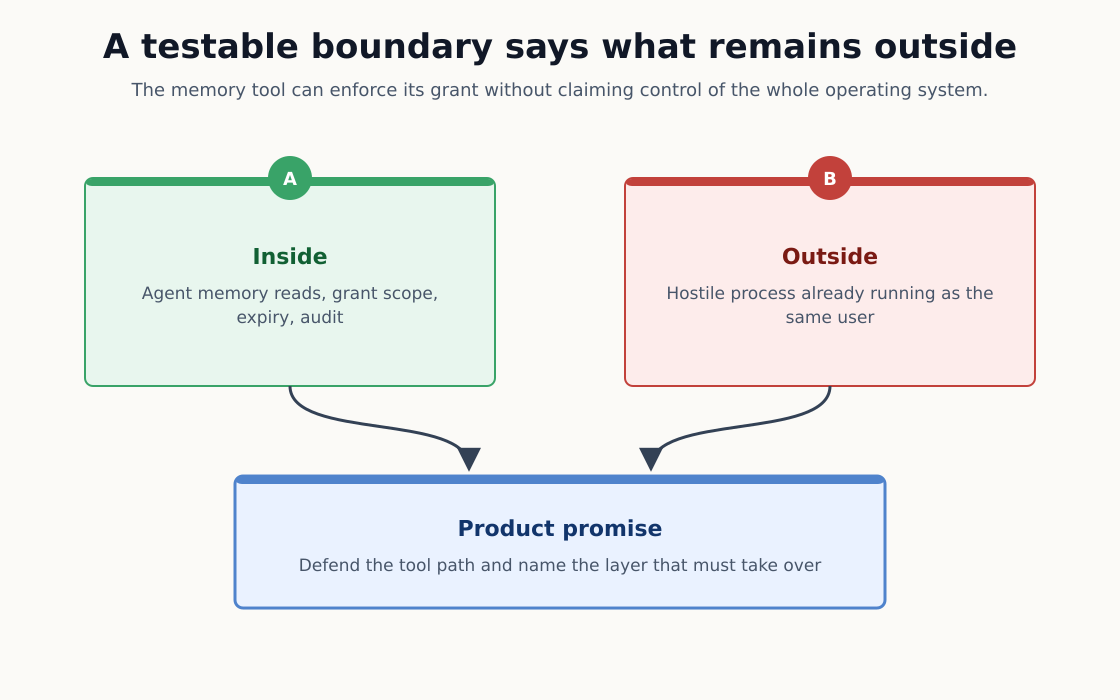
The sensitivity grants defend the memory tool surface. An AI client can search and recall ordinary memory but cannot grant itself access to higher sensitivity tiers. The product does not claim that this mechanism can stop a hostile process already running as the same operating-system user from reading files that account is allowed to read. That is a different boundary with different controls.
The distinction may sound narrow until something goes wrong. A broad promise such as “your private data is protected” gives the user no way to understand which threat the product actually considered. A narrower statement explains what the gate controls, which actor sits outside it, and where another layer must take over.
A security model needs that edge. Otherwise every permission prompt becomes a little ceremony attached to a promise nobody can test.
Write Down What the Click Creates
There is a practical way to expose gaps before the interface copy begins:
Start with the actor by naming who is asking and who is allowed to approve.
Define the records, actions, account, device, or sensitivity tier covered by the grant.
Set the lifetime, renewal rule, and effect of a logout, restart, upgrade, or crash.
Provide a revocation path that can reduce access without recreating the approval ceremony.
Record enough evidence to show that authority was granted and used without copying the sensitive material into the log.
Name the boundary the permission does not defend so the rest of the design does not rely on an imaginary protection.
The decisions can fit on one page before they become code. If the team cannot answer them in plain language, the prompt is arriving too early.
Friction Has to Carry Meaning
The answer is not to ask the user more often.
Prompts impose a cost. When the same box interrupts every ordinary action, people learn that the fastest route is approval. The interface creates the appearance of consent while training the behavior that empties consent of meaning.
Useful friction appears where the person’s presence changes the authority of the system. Meaningful interruption tells the user what is changing and lets the routine work continue without repeated ceremonies.
In MOOTx01, grant lifetime therefore matters to product design. A thirty-minute window may cover a focused task without demanding another approval for every read. A day boundary may fit material that remains useful throughout ordinary work. A restart reset gives the user and the system a simple recovery point.
There is no duration that fits every product. The design has to connect the sensitivity of the action with the rhythm of the work and the cost of interruption.
The goal is not the smallest number of prompts. It is the smallest number of meaningful prompts backed by behavior the user can rely on.
The Work Behind the Button
AI can help inspect a permission model. It can enumerate the code paths that create a grant, compare two platform implementations, and repeat tests at the expiry boundary. A tool-inventory scan can find an approval handle that should not exist and verify that a restart clears the ledger. The work applies analysis, context, and iteration to a security promise.
The machine cannot choose the promise by itself. Experience tells us that people approve access while concentrating on another goal. Perspective asks what the next session inherits from the current user’s click. Imagination considers how an agent might keep a sliding grant alive or use an apparently harmless status call to learn that hidden records exist. Those human lanes determine what the tests should prove.
The prompt is still part of the product. Its language should be clear, its timing should make sense, and its choices should match what the system can enforce. The mistake is asking the prompt to carry the whole design because it is the only part the user sees.
The box disappears after the click. The responsibility stays in the product until the authority ends.
Off-Axis Labs: All the science, fewer casualties.
Source Notes
MOOTx01 maintainers,
docs/engineering/SYSTEM_ENGINEERING_REFERENCE.md, section 7.4, “Human sensitivity grants.”MOOTx01 maintainers,
docs/reference/ARIA_MCP_SPEC.md, section 19, “Sensitivity unlock/lock control endpoints.”MOOTx01 maintainers,
packages/kits/AriaMcpKit/Sources/AriaMCP/SensitivityGrantLedger.swift.MOOTx01 maintainers,
CHANGELOG.md, v1.0.17.MOOTx01 Git history:
e93da4a0for the in-memory grant ledger and recall ceiling, and44fa3f92for the out-of-band control routes.
How I Write With AI
These articles are written with AI, but the AI does not decide what I believe. I bring the experience, evidence, conclusions, and responsibility for every word. The AI helps me structure and edit that material according to rules I developed over 35 years of business writing.
A few of those rules: begin with a situation the reader recognizes; establish the consequence and useful question within three paragraphs; teach through a real causal story; explain technical ideas in ordinary language; acknowledge the strongest fair complication; cite the evidence; and remove jargon, marketing language, fake certainty, and synthetic rhythm. Chicago supplies the style. Kate L. Turabian supplies the intellectual discipline. Thank you, Kate.
In short, I have taught the AI to write the way I write. That matters because I respect your time. We are working on large intellectual systems with knowledge worth sharing, but the work has traditionally accumulated faster than I could explain it well. AI can now carry much of the structural and editorial load without reducing the ideas to slogans.
If you wonder whether the voice is really mine, try the Listen function. The articles sound like me because the experience is mine, the rules are mine, the judgment is mine, and—most importantly—the message is mine.