

Over the years, I have become suspicious of one sentence in software:
“It works on my machine.”
That sentence is usually true. That is the trouble with it.
It means the programmer knows which command to run, which warning to ignore, which old file can be deleted, which port is supposed to be open, and which strange behavior is left over from last Tuesday’s experiment. The software works because the person who made it is still wrapped around it.
AI coding has made that stage easier to reach. A person with a problem, a laptop, and enough patience can sit down with an AI assistant and end the day with a script, a dashboard, a local app, or a workflow that did not exist that morning.
That is real leverage. It is also familiar leverage.
The spreadsheet did something similar. It let people build tools without waiting for a software team. A finance person could make a forecast. An operations person could track inventory. A manager could wire together a planning model that fit the work in front of them. The first useful spreadsheet felt like a small act of wizardry. After a while, it became Tuesday.
Then came the second lesson. The workbook that runs one person’s desk is not the same thing as the system that runs payroll. The sheet that works because Erin knows which cells not to touch is useful, but it is not ready for a department.
AI coding is walking into that same lesson, just faster.
We hit it with MOOTx01 during a release-readiness pass.
MOOTx01 is private memory for AI tools. The basic promise is easy to say and hard to make dependable: the user’s memory should belong to the user, survive across sessions, and remain useful across different agents and tools.
In the beginning, the visible work looked like memory work: search, recall, storage, indexes, permissions, and the part where an AI needs to remember without pretending every search result is the same as memory.
Then we looked at a real machine and found five mootx01 serve processes running.
We wanted one.
One process was the resident daemon. That was the right one. One came from the Claude Code plugin. Two came from development rigs. Another came from the ordinary path every useful tool eventually meets: install the binary, try the plugin, run the setup assistant, come back later, follow the README again because the first attempts happened on different afternoons.
That was the part worth noticing. Nobody had to be foolish for the machine to end up in that state.
The CLI installer had a job. It wired clients to the local daemon. The plugin had a job. It gave Claude Code a declarative way to connect to MOOTx01. The development builds had a job. They let us test the thing while we were still changing it.
Each piece made sense when viewed alone.
Together, they created a product problem.
Memory systems care about writers. Two readers can often share politely. Two writers can turn the future into a group project nobody signed up for. A private serve process beside the resident daemon was not a nice extra connection. It was a second hand on the same notebook.
For a prototype, that kind of problem is annoying. The programmer can kill the process, edit the config, remember which install path came first, and keep moving.
For a product, it is a warning light.
That was the turn. We had crossed the line from “can this work?” into “can someone else rely on this without knowing the history?”
The answer was no, not yet.
That “not yet” is where product work begins.
The fix was not to write a better paragraph in the README and hope the user followed it exactly. The fix was to move the missing knowledge out of the programmer’s head and into the system.
The connection ownership decision recorded the new rule: one client gets one MOOTx01 connection, and that connection reaches the resident daemon. The plugin should use loopback HTTP where the client supports it. No shipped manifest should spawn a bare mootx01 serve process. The installer should detect plugin ownership, skip competing direct wiring, and clean up stale entries it owns. Development builds should have visible names in ps so a test process does not pretend to be the product.
That work will never sell a keynote. It may save the user from losing an afternoon.
The work that makes software dependable often looks boring from a distance: install behavior, upgrade behavior, version checks, process names, config ownership, and failure messages that tell the user what to do next.
Those details are easy to dismiss until they become the user’s first real experience of the product.
The user did not ask for connection ownership. The user asked for memory.
That is the blind spot that keeps returning.
Users ask for the thing they can name. They feel the cost of the parts they cannot name.
They do not care whether the plugin uses HTTP, stdio, or a bridge process. They care whether their agent remembers yesterday’s decision. They do not care which install moment owns the MCP entry. They care whether the next upgrade leaves them with one working memory system instead of three half-working ones.
The same lesson showed up again in security.
MOOTx01 needs to handle private material. That means the system has to read some things only when the human permits it. It also means the agent must not be able to grant itself that permission.
The sensitive unlock boundary drew the line in a different place. Approval does not travel through the MCP tool surface. There is no model-callable unlock tool. The human approves out of band. Private access expires. Secret access expires faster. Reads under a grant are audited. If the daemon restarts, the grants disappear.
That is security policy. It is also product design.
A prompt-injected model should not be able to talk the product into opening the user’s private rows. The user should not have to understand the entire threat model to get that protection. The product has to carry the boundary.
Release control taught the same lesson from another direction.
A serious user needs to install, upgrade, verify, and recover. The release runbook now names the order: update the package and plugin versions, regenerate generated assets, build and sign release artifacts, publish Homebrew and plugin channels, tag SDK venues, and smoke test the marketplace path on a machine with the public binary.
That checklist is not paperwork. It is a memory aid for the team written before fatigue gets a vote.
This is the part of AI-assisted development that deserves more attention.
The exciting demo is the prototype appearing quickly. The durable value comes later, when the team removes the hidden dependency on the creator.
AI helps with that work. It can compare versions, chase references, read the codebase, produce tests, and try the next patch while the human is still sorting out where the real risk lives. On the right day, that feels like getting an extra set of hands that never gets bored of grep.
That is useful. It is not the same as judgment.
The machine brings analysis, context, and iteration.
The human still has to bring experience, perspective, and imagination.
Experience says people install things twice, in the wrong order, while tired.
Perspective says the user does not experience “transport policy.” The user experiences “my AI stopped remembering things.”
Imagination says the manual is no longer only for the human.
That last point matters more than it used to.
We used to carry a small joke around documentation: you still have to write the manual, and your users still will not read it. AI changes the second half. Your users may not read the manual. Their AIs might.
That makes documentation part of the interface. It teaches an agent what handles exist, which order to use them in, what shortcuts are forbidden, and which failures need human judgment.
In one MOOTx01 test, the difference was not subtle. My plan was to have the AI extract Apple developer transcripts one at a time, format each one, and inject each transcript through the single-memory path. The agent looked at the available surfaces, found the bulk import path, and used the Obsidian vault importer instead. Hundreds of transcript files moved in minutes instead of hours.
That was not because the agent was magic. It was because the system had a legible surface and enough documentation for the agent to find the better tool.
You still have to write the manual.
Now you may be writing it for a human reader and an agent reader.
This is why I think the current AI awe is pointed at the wrong finish line. Making a one-off tool is becoming common. That is good. More people should be able to make useful software for their own work.
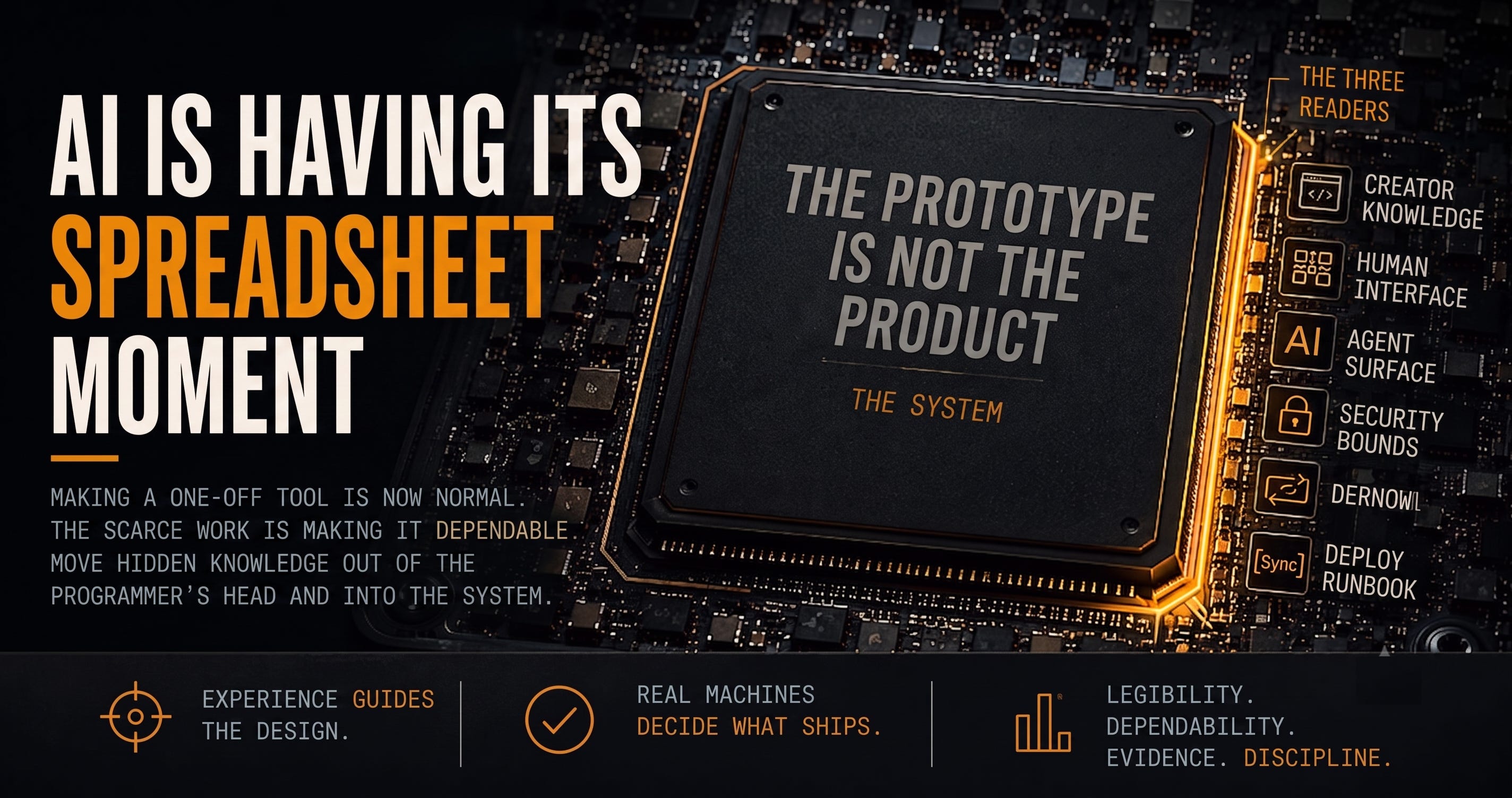
AI coding is having its spreadsheet moment. A spreadsheet can save a business. It can also become the thing everyone is afraid to touch. You can write a complex ERP in Excel. People have. That does not make it a good idea.
But “good enough for my desk” and “ready for users” are different promises.
The first promise says, “I can make this work.”
The second promise says, “You can depend on this when I am not standing next to you.”
For the moment, dependable software has three readers.
The first reader is the creator. The creator knows the scars. The creator remembers why the config looks strange, which command fixed the daemon last time, and which shortcut was supposed to be temporary.
The second reader is the human user. That person needs the product to behave without learning the entire backstory. They need setup, upgrade, uninstall, permissions, recovery, logs, version checks, clear docs, and tests that catch the boring regressions before a tired user does.
The third reader is the AI agent operating the product surface on the user’s behalf. That agent needs names, affordances, constraints, examples, and recovery paths clear enough that it can choose the right handle instead of guessing.
Today, the product has to meet all three readers where they are.
Eventually, more of the interface may be written for agents first. That may shrink part of the problem. We are not there yet. Today it expands the job because the system has to be legible to the creator, usable by the human, and operable by the agent.
AI can help carry those obligations. It can carry more of them every month.
It cannot decide why the obligations matter.
That remains our lane.
The prototype proves that a path exists. The product proves that someone else can walk it.
This series starts there because the lesson will keep coming back. The bottleneck will move. Sometimes it will be math. Sometimes storage. Sometimes the pipeline. Sometimes security. Sometimes the trigger that fired too early or the installer that left one old entry behind.
The work is to keep asking where the hidden human knowledge still lives, then move enough of that knowledge into the system that the next person gets the value without inheriting the experiment.
That is not less creative than building the prototype.
It is the part where the work starts belonging to other people too.
Off-Axis Labs: All the science, fewer casualties.