


Two People Leave the Same Meeting
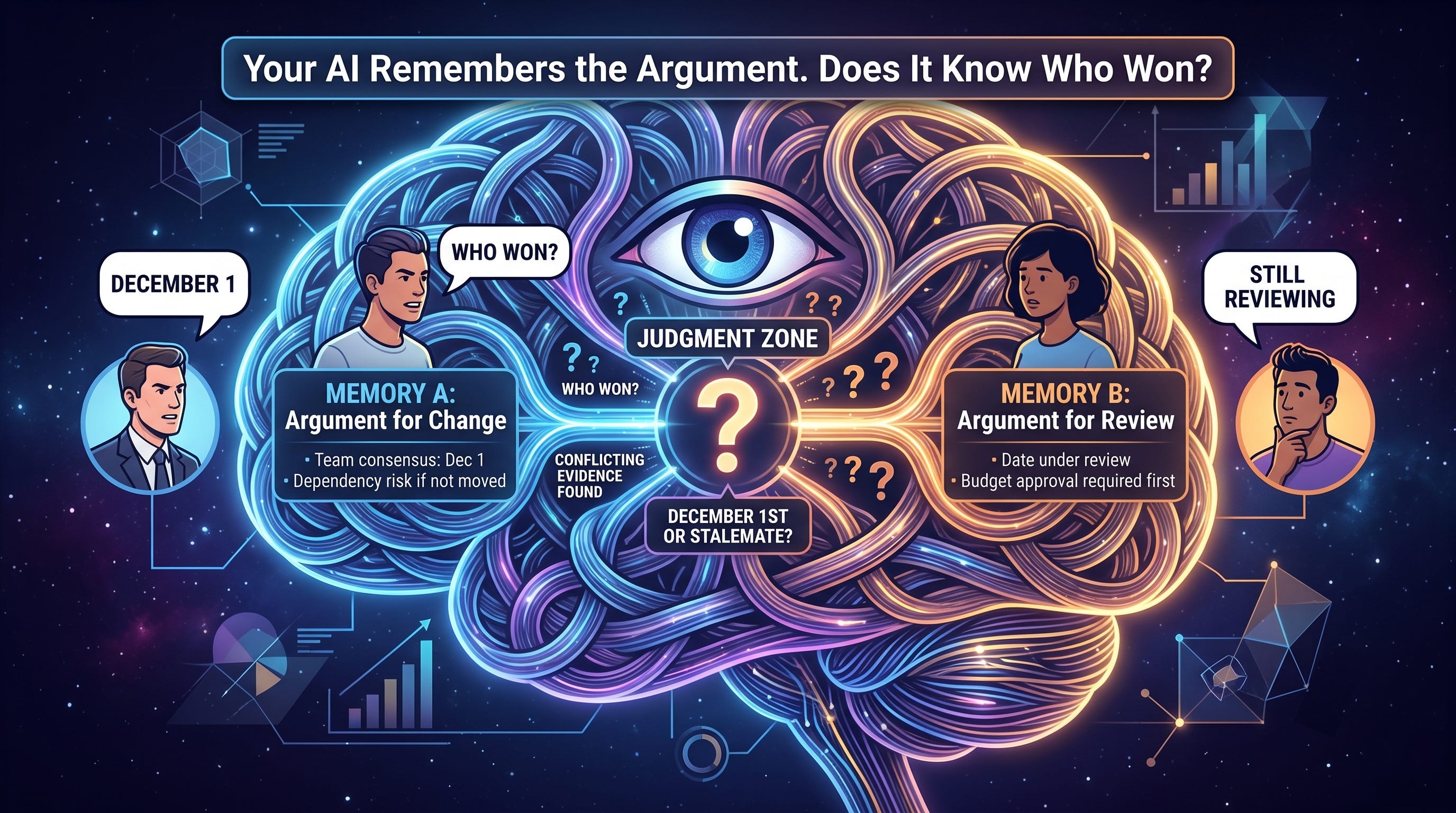
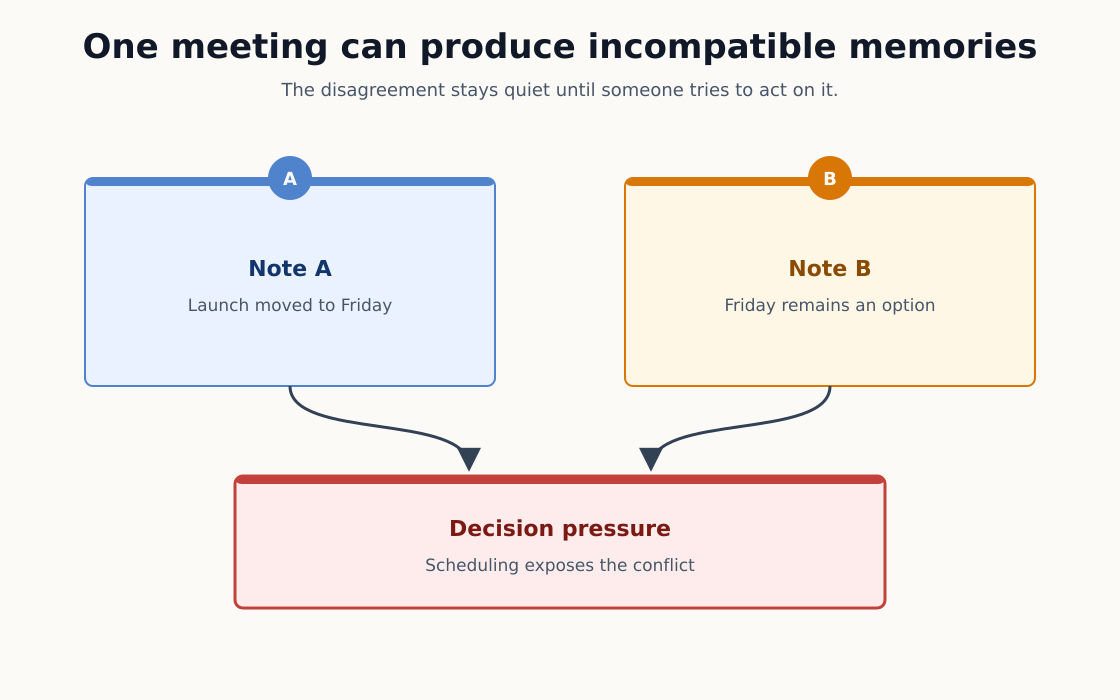
Two people can leave the same meeting with different versions of what was decided. One writes that the launch date moved. The other writes that the date remains under review. Both notes are clear, and both authors believe they captured the room correctly.
The disagreement may remain invisible until someone uses a note to schedule work.
A shared document makes the page look tidy by keeping one current body of text. Someone can edit the date, delete the weaker sentence, and move on. The final page gives the team an answer, but it may remove the evidence that an argument ever existed.
That missing history matters when the decision is challenged later. Who changed the date? What evidence settled it? Did the team resolve a disagreement, or did the last person with the document simply win the edit?
Memory has always had this problem. AI makes it easier to create conflicting records and easier to act on one before anyone notices the other.
An agent working in one session may record a workaround as the new procedure. Another agent reads the underlying documentation and records the original rule. Both memories contain useful evidence. A third session searches for the procedure and receives whichever version resembles the question most closely.
The system needs more than the ability to save and edit text. It needs a way to say that two records disagree and a way to settle what should guide the work now.
Stale and Wrong Are Different Problems
The previous memory chapter dealt with a lesson that was correct when written and became dangerous after conditions changed. A temporary bypass can outlive the outage that justified it. The record remains accurate history even after it should stop directing current work.
Disagreement begins somewhere else. One memory may be wrong from the start. Two records may describe different understandings of the same event. A new piece of evidence may prove that an approved answer rested on a bad assumption. Time can reveal the conflict, but age did not create it.
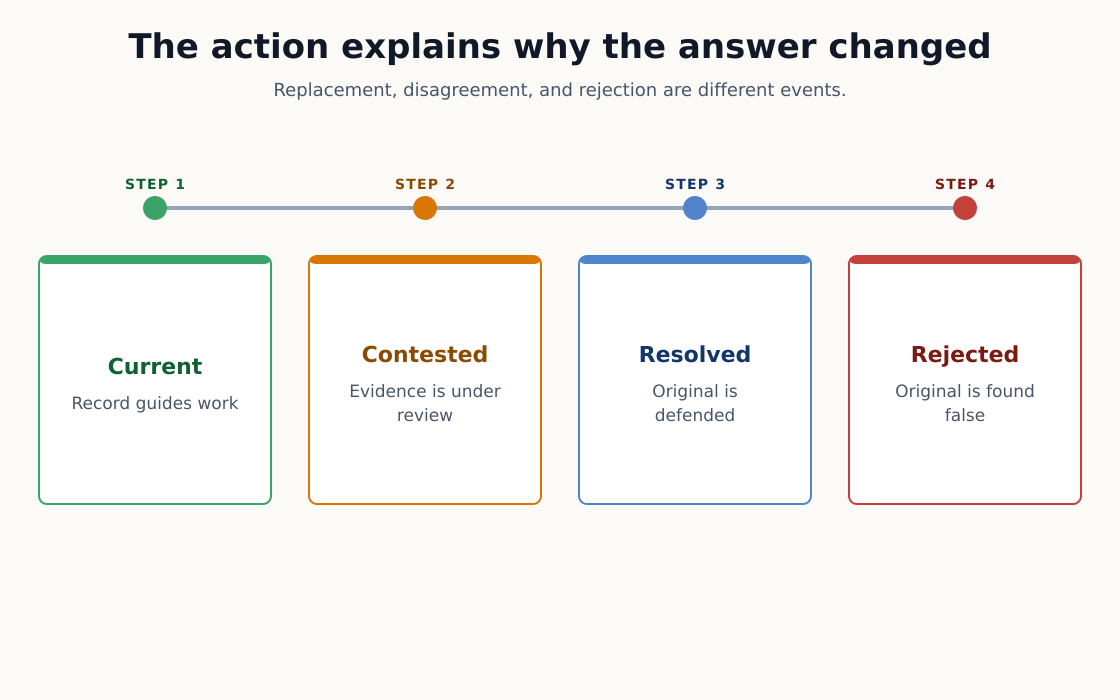
The distinction changes the response. A stale lesson may be superseded by a newer answer. A disputed lesson needs to be contested while the evidence is examined. If the original survives review, the dispute can be resolved. If the evidence shows the original was false, it can be rejected.
Deleting the losing record would make ordinary search easier. It would also erase the trail needed to understand earlier work that followed it.
A dependable system has to perform both jobs. Current work needs a settled view, while later review needs the disagreement and its outcome.
Editing Is Too Quiet
Files are excellent at representing a current document. They are less helpful when the change itself carries meaning.
Suppose a memory says that customer exports may include private records. A person later discovers that the approved policy excludes them. Replacing one sentence with the other produces a correct current file. It does not reveal how long the earlier instruction was active, which agent wrote it, or which work may have relied on it.
Version control can preserve the old bytes. The commit history still needs someone to explain what the edit meant. Was it a correction, a policy change, a rewording, or the resolution of a dispute?
That meaning belongs in the operation. Our memory system uses named changes for that reason. A memory can be confirmed, contested, resolved, superseded, rejected, or revived. Each word carries a different consequence for the current view and the historical record.
The terms only help after the process gives them meaning. Contest means the current answer is under active dispute. Resolve means review preserved the answer and settled the contest. Reject means the evidence showed the memory should not guide work. Supersede means a newer record now holds the current answer while the earlier record remains part of the lineage.
The memory does not silently become different text. The system records an action that explains why its authority changed.
The Missing Route
The value of that grammar became clearer when we found a small defect in it.
The design has a route map for legal memory changes. Programmers call it a state machine, but the idea is ordinary. A pending memory can move through certain doors. An accepted memory has different doors. Illegal shortcuts are blocked so one tool call cannot quietly turn any record into any state.
The list of memory verbs said that a contested record could be rejected. The route map did not include that door.
As a result, the system could mark a memory as disputed and later resolve the dispute in its favor. It could not finish the other valid outcome by rejecting the contested memory. The attempted change stopped as an illegal transition.
The fix was only a few lines. The lesson was larger.
Once memory changes carry meaning, the complete path matters. “Contest” is not a decorative label. It creates a question that needs legal outcomes. A route map that allows only one ending has already prejudged the review.
The repair added the missing transition in both implementations and tests that proved the valid route worked. The tests also protected other boundaries. An accepted record still could not be rejected through the same shortcut, because changing a settled answer requires the appropriate process.
This is what familiar engineering tools contribute to agent memory. A state machine makes the vocabulary enforceable. Tests preserve the allowed and forbidden routes. The audit log records which route was used. None of those ideas began with AI, but AI gives them a new place to matter.
Keep the Argument Beside the Answer
The practical strategy is to preserve four pieces of the change:
Keep the original evidence because a disputed memory may explain why earlier work looks the way it does.
Record the disagreement instead of letting a conflicting statement sit beside the current answer with equal authority.
Name the outcome because resolution, rejection, and supersession answer different questions.
Connect the records so the current answer points through the change that gave it authority and later review can follow the same path in reverse.
Organizations do not need MOOTx01’s exact vocabulary, but they do need explicit words and behavior for these changes. A system with only create, update, and delete forces every meaningful correction through verbs that cannot express the difference.
The result may look clean in the interface while remaining ambiguous everywhere that matters.
The Machine Can Find the Dispute
AI is useful before and after the moment of judgment. The machine can compare large collections, find near-duplicates, and notice statements that differ by a date, a number, or a negative word. A second pass can gather the source records and show how each answer entered the system. That work brings analysis, context, and iteration to a review that a person might never have time to prepare by hand.
The model should not settle every apparent contradiction alone. Two statements can sound incompatible because they describe different customers, releases, or points in time. A change in policy may be a real evolution rather than proof that the older record was false.
Experience recognizes the condition omitted from one sentence. Perspective asks whose work will change when one version becomes current. Imagination considers whether both records reveal a third explanation the original authors did not see.
The human contribution gives the disagreement its meaning. The machine makes the evidence practical to inspect.
A Memory With a Past
Persistent memory is often described as the cure for agents that forget. That is only the first problem.
A useful memory will eventually collect guesses, discoveries, decisions, exceptions, and corrections from more than one session. Some will agree. Others will expose a system that misunderstood the work and needs to change its answer.
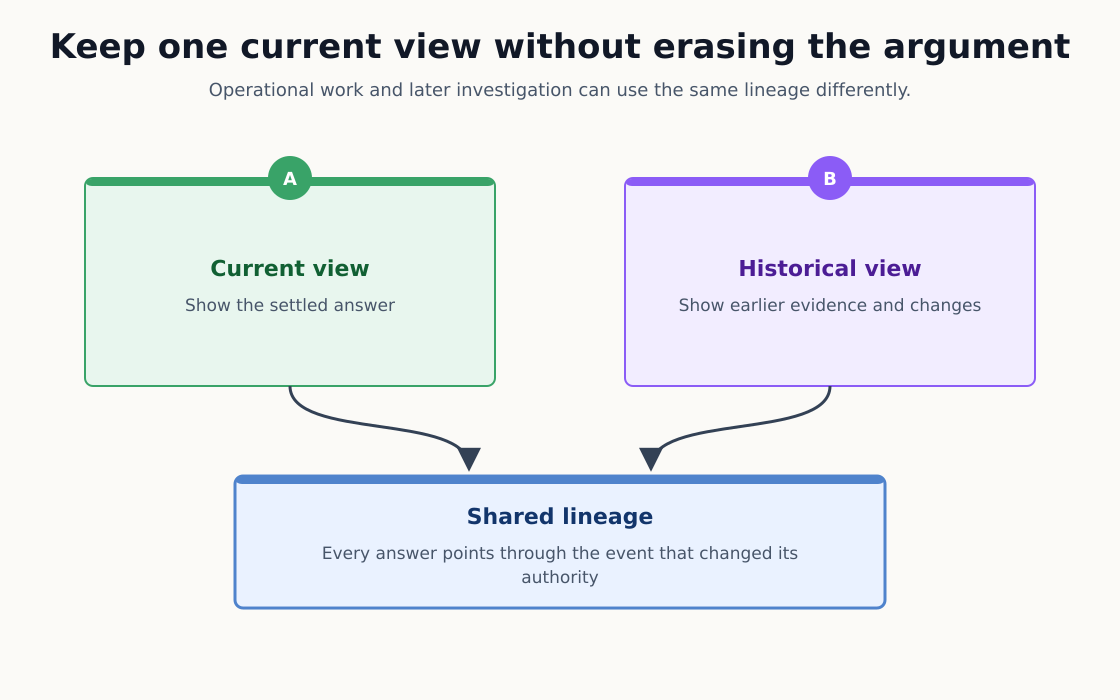
Erasing the old record gives the current session a cleaner page. Preserving every version with equal authority gives the next session a mess. The product has to keep the history and still provide a current view.
That requires judgment expressed through familiar tools: states, legal transitions, provenance, links, and audit. AI can help keep the system moving, but people still own the moment when evidence becomes policy.
Memory becomes useful when it survives the session. It becomes dependable when it can change its mind without pretending it never thought differently.
Off-Axis Labs: All the science, fewer casualties.
Source Notes
MOOTx01 maintainers,
packages/libs/SubstrateLib/Sources/SubstrateLib/RowStateAutomaton.swift.MOOTx01 maintainers,
packages/kits/LocusKit/Tests/LocusKitTests/MutateMutationKindTests.swift.MOOTx01 maintainers,
docs/concepts/ARIA.md.MOOTx01 maintainers,
packages/PACKAGES.md, LocusKit lifecycle and mutation responsibilities.MOOTx01 Git history:
b6655a5cfor the contested-to-rejected transition repair, andb21c6acdfor later confirmation-path boundary tests.
How I Write With AI
These articles are written with AI, but the AI does not decide what I believe. I bring the experience, evidence, conclusions, and responsibility for every word. The AI helps me structure and edit that material according to rules I developed over 35 years of business writing.
A few of those rules: begin with a situation the reader recognizes; establish the consequence and useful question within three paragraphs; teach through a real causal story; explain technical ideas in ordinary language; acknowledge the strongest fair complication; cite the evidence; and remove jargon, marketing language, fake certainty, and synthetic rhythm. Chicago supplies the style. Kate L. Turabian supplies the intellectual discipline. Thank you, Kate.
In short, I have taught the AI to write the way I write. That matters because I respect your time. We are working on large intellectual systems with knowledge worth sharing, but the work has traditionally accumulated faster than I could explain it well. AI can now carry much of the structural and editorial load without reducing the ideas to slogans.
If you wonder whether the voice is really mine, try the Listen function. The articles sound like me because the experience is mine, the rules are mine, the judgment is mine, and—most importantly—the message is mine.